The recycling of insulation waste is a particularly difficult task in the case of rigid polyurethane and polyisocyanurate foams. These materials are widely used in cold rooms, industrial insulation systems, building structures and sandwich panels because of their low thermal conductivity and good dimensional stability.
The challenge is that PU and PIR foams are thermoset, crosslinked materials. This means they cannot be remelted and reprocessed in the same way as many thermoplastic materials. As a result, the treatment of production scrap, installation waste and dismantled insulation materials is a more complex engineering problem.
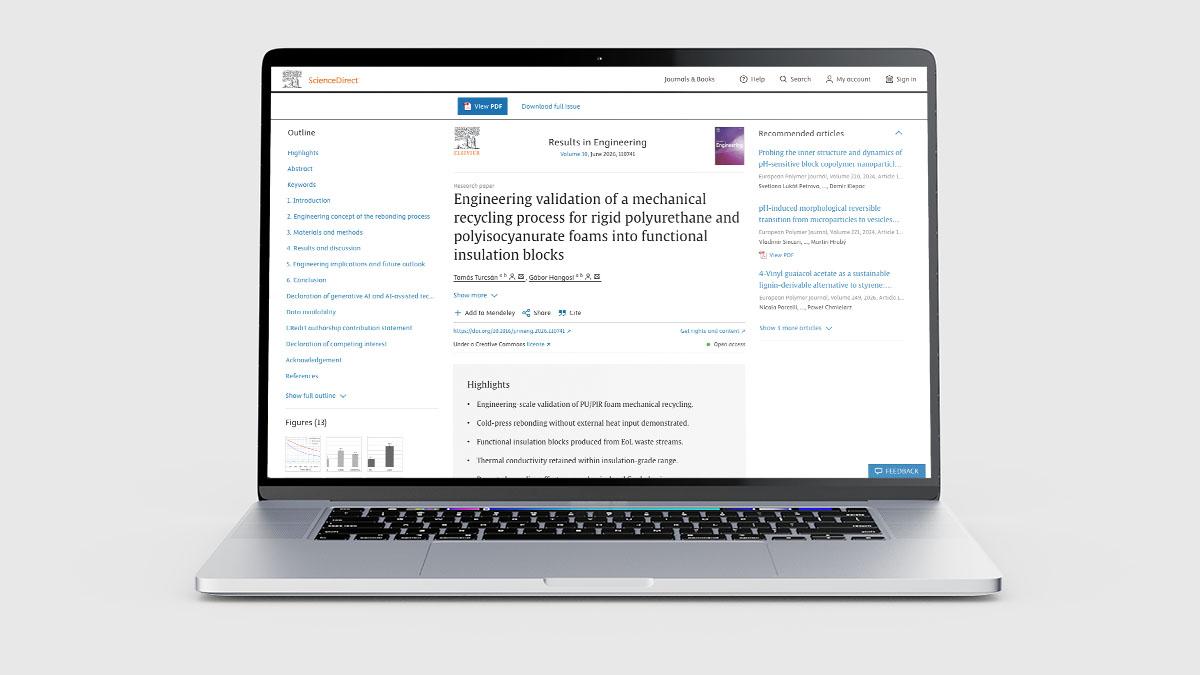
A scientific publication authored by our specialists examined whether rigid PU/PIR insulation foam waste can be mechanically recycled into new, functional insulation blocks.
Mechanical recycling and rebonding
The technology examined in the study is based on shredding and reactive rebonding. In the process, PU/PIR foam is first shredded into smaller particles, then the foam particles are coated with a binder. The material is then formed into new insulation blocks in a closed mould using cold pressing.
The binder system used in the research consisted of an MDI prepolymer, a lignin-containing reactive component and water. In some samples, potassium silicate, also known as water glass, was also used. In this case, lignin was not used simply as a filler, but as an active, reactive component of the binder system.
One of the key findings of the study was that curing took place without external heat input. The process relied on the heat generated by the binder reaction itself, meaning the blocks were produced under cold-press conditions.
Industrial-scale validation
The publication went beyond laboratory specimens. During the research, we produced rebonded insulation blocks measuring 0.5 × 1.2 × 2.0 metres, demonstrating that the process was validated beyond small-scale test samples. This is important because the practical applicability of the technology cannot be assessed based on small specimens alone.
The feedstocks included PIR production scrap and dismantled PU cold-room insulation that had been in service for more than 20 years. The research also evaluated first-cycle and second-cycle recycling, making it possible to assess not only the first processing step, but also the effect of repeated recycling.
What did the tests show?
The thermal conductivity of the recycled blocks increased compared with the original PIR material, which was an expected result. Shredding partially damages the closed-cell structure, while the binder increases the density of the material.
Nevertheless, the thermal conductivity values of the recycled blocks remained within the typical range of polymeric insulation materials. In the publication, the thermal conductivity of the tested samples was approximately 0.033–0.041 W/mK.
Based on the compressive strength tests, the materials showed mechanical performance suitable for non-load-bearing insulation applications. In the case of PIR, repeated recycling increased density and reduced mechanical performance. In the case of PU, however, first-cycle recycling improved the compressive properties compared with the aged reference material. This suggests that the binder matrix was able to connect the aged, fragmented PU foam particles and improve load distribution.
Fire performance and water vapour transmission
Our publication also included ignitability and cone calorimetry tests. Based on the results, recycling did not cause a critical deterioration in fire behaviour. The potassium silicate-modified PIR sample showed more favourable flame spread results than the unmodified, once-recycled PIR sample.
However, these results do not constitute an official fire classification. Full classification requires further standardised testing.
Water vapour permeability tests showed that the recycled materials had higher vapour permeability than conventional closed-cell PU/PIR foams. This was caused by the partial opening of the cellular structure during shredding and rebonding. This may be beneficial in certain building assemblies, but moisture-related risks must always be assessed separately from a building physics perspective.
What does the publication demonstrate?
Based on the research, the recycling of insulation waste from PU/PIR foams is not only a theoretical possibility. The technology based on shredding and reactive rebonding may be suitable for producing industrial-scale insulation blocks.
The key message of our publication is that rigid PU/PIR waste can be converted into rebonded insulation blocks with measurable thermal insulation performance and mechanical properties. These results are especially important for the value-added recovery of production scrap and end-of-life insulation materials.
Authors