The shift toward a low-carbon economy and the growing focus on CO₂ reduction, ESG, and green building standards are being shaped by stricter global regulations, environmental challenges, and changing market expectations. Across industries, CO₂ reduction targets are becoming mandatory rather than optional. Companies are under increasing pressure to reduce emissions not only in their own operations, but also across their products and supply chains.
In this context, innovative PU recycling is becoming increasingly relevant for companies seeking practical ways to reduce the environmental impact of material use. At the same time, ESG reporting requirements and the expectations of customers and investors are making measurable environmental performance more important than ever.
Today, it is no longer enough to make general “green” claims. Businesses are expected to provide clear proof of a lower environmental footprint.
In construction, this shift is especially visible in green building requirements. Project briefs influenced by LEED and BREEAM increasingly treat low-carbon materials as a standard selection criterion. As a result, materials that can support lower emissions and contribute to more sustainable building outcomes are becoming an essential part of modern project planning.
What exactly is low-carbon PU foam?
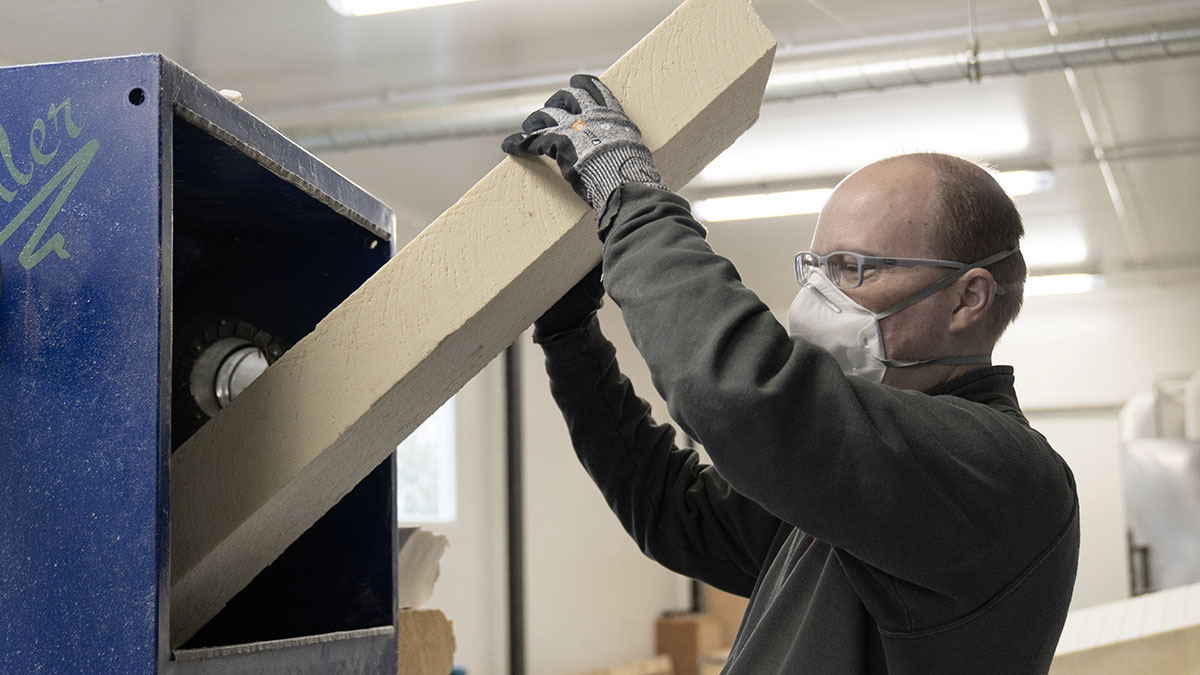
Low-carbon PU foam is recycled rigid polyurethane foam that is rebuilt into new blocks through a lower-impact process. Instead of relying entirely on fossil-based inputs, the material is produced using a more sustainable approach that can also incorporate bio-based binders where possible. This makes low-carbon PU foam a practical option for companies looking to reduce material-related environmental impact without moving away from the performance benefits of rigid polyurethane.
Where does the CO₂ saving come from?
Recycling (waste diversion + circularity):
The biggest CO₂ benefit comes from keeping rigid PU waste out of landfill and incineration. By mechanically recycling it into usable material again, companies support circularity and reduce the material’s overall carbon impact.
Bio-binder (lower fossil dependency):
Replacing conventional petroleum-based binders with bio-based binders helps reduce fossil carbon in the formulation. This lowers the binder-related footprint while supporting a more sustainable material composition.
Energy (efficient mechanical process):
Mechanical recycling and rebinding typically requires less energy and fewer chemicals than complex chemical recycling or producing virgin PU from scratch. As a result, the process can offer a lower-impact way to create new usable material.
Lifecycle (performance + extended use):
Rigid PU foam is a high-performance insulation material, so using it in long-life applications can reduce energy demand over time. Recycling also helps extend the material’s life within a more circular system.
How low-carbon PU foam is made with the Purman® method?
The Purman® method turns rigid PU foam waste into new high-performance blocks through a lower-impact mechanical recycling process. By combining waste collection, grinding, bio-based rebonding, and an energy-efficient curing method, the process helps create durable recycled PU products for a range of industrial applications.
- PU Waste Collection: The process begins by gathering rigid PU foam waste from three primary sources: manufacturing defects (5–15% loss), on-site construction scraps (3–5% loss), and end-of-life (EoL) materials from buildings and appliances.
- Grinding: This waste is physically processed by grinding it into fine particles or powder.
- Bio-based Rebonding: These particles are then bonded using lignin, a natural and renewable polymer from plant cell walls (a byproduct of the paper industry), which significantly reduces the need for traditional petroleum-based binders.
- Exothermic Reaction (No External Heat): A significant innovation of the method is that it requires no external heating; the chemical reaction is exothermic, meaning it generates its own heat to cure the material, drastically reducing energy consumption and CO₂ emissions.
- New Blocks and Products: The result is high-performance, durable recycled PU blocks that can be cut into insulating boards, structural panels (SIPs), or custom shapes for the furniture and automotive industries.
Circular Economy Logic
Low-carbon PU foam supports circular economy principles by turning rigid PU waste into a high-performance secondary raw material. With the help of bio-based binders such as lignin, the material can be reintegrated into the value chain. At the same time, it helps avoid disposal by diverting non-degradable foam from landfill and incineration, reducing toxic and CO₂ emissions while also helping companies avoid high disposal fees.

Technical Performance vs. Conventional PU Foams
Low-carbon PU foam does not only support sustainability goals, but also delivers strong technical performance across multiple applications. Compared to conventional PU foams, it offers a balanced combination of insulation, acoustic performance, strength, and practical handling.
Vapour Diffusion and Balanced Building Performance
Low-carbon PURMAN® PU foam stands out not only for its excellent thermal insulation performance, but also for its optimized vapour diffusion properties. Thanks to its semi-closed cell structure, the material creates an ideal balance between vapour resistance and controlled breathability. This allows it to effectively regulate moisture while helping prevent condensation and moisture-related issues within building structures. The combination of outstanding thermal insulation and balanced vapour management makes PURMAN® a highly effective and reliable solution for modern building insulation applications.
Thermal insulation
It offers excellent thermal insulation, with a thermal conductivity between 0.028 and 0.034 W/(m·K), matching or even exceeding the performance of XPS insulation boards. Like conventional PU foam, it remains highly energy-efficient and can support energy-efficient building concepts, including passive-house-oriented designs and green building projects.
Vibration and noise damping
Purman® products, such as door cores and inserts, can significantly improve the acoustic performance of buildings and openings like doors and windows. The denser material structure also provides effective sound insulation in industrial and construction applications.
Strength
The lignin binder increases compressive strength to 100–200 kPa at 10% deformation. This makes the material structurally robust and suitable for applications such as structural insulated panels (SIPs) and furniture frames.
Weight and density
The recycled foam has a density of 70–110 kg/m³, compared to virgin foams typically at 20–40 kg/m³, making it more solid while still remaining lightweight. Despite the higher density, it stays easy to handle and maintains a strong strength-to-weight ratio. This is especially valuable in applications such as automotive and marine components, where a strong strength-to-weight ratio matters.
Where low-carbon PU foams are most effective
Low-carbon PU foams are especially valuable in applications where durability, insulation performance, customization, and sustainability all matter. Their versatility makes them suitable for a wide range of industries and end uses.
- Building materials / building structures: Recycled PU foam blocks can be used as raw material for building-product manufacturing, where durability and insulation value are both important.
- Doors & openings (windows/door systems): Recycled PU can be turned into high-performance inserts and cores that improve thermal and acoustic performance while supporting energy-efficient buildings.
- Logistics protection: The material can be used to produce customizable protective packaging and transport protection elements that help reduce damage and optimize handling.
- Furniture components: Recycled PU blocks can serve as a sustainable, high-performance raw material for furniture production.
- Waterfront / outdoor furniture & floating elements: Recycled PU can also be used to manufacture eco-friendly waterfront furniture and aquatic elements.
- Custom blocks for industrial parts: The material can be shaped into component products for diverse applications, including construction and automotive, where tailored sizes and forms are needed.

Low-carbon PU foams & certifications (LEED, BREEAM, ESG)
Low-carbon PU foams can support green building and ESG goals in several practical ways. Their recycled content, insulation performance, transparency potential, and use of more sustainable inputs make them relevant in certification-focused projects.
Recycled Content
These foams can contribute to LEED and BREEAM documentation where recycled content is relevant to the project’s selected credits and assessment pathway.
Energy Efficiency
Rigid PU foam is highly valued in certification systems because, as an insulation material, it can save over 100 times the energy required for its initial production during its service life. Its low thermal conductivity of 0.028 to 0.034 W/(m·K) also helps improve building performance and meet strict energy-saving criteria.
EPDs and Transparency
Where Environmental Product Declarations (EPDs) are available, they can improve product transparency and support project documentation in green building assessments.
Sustainable Materials
Using bio-based binders such as lignin can strengthen the material’s sustainability profile by reducing reliance on fully fossil-based inputs.
Reportable CO₂ Savings and ESG Impact
Low-carbon PU foams can also support measurable sustainability reporting. Their production and recycling logic make it easier for companies to document carbon savings and demonstrate progress within ESG frameworks.
Elimination of External Heating
The Purman® mechanical recycling process is highly energy-efficient because the chemical reaction is exothermic, so it requires no external heat during production. This helps drastically reduce the operational carbon footprint compared to traditional chemical and conventional mechanical re-bonding methods.
Avoided Incineration and Landfilling
By recycling PU waste instead of incinerating it, companies can avoid the significant greenhouse gas emissions and toxic substances released during combustion. Diverting this waste from landfills also supports broader efforts to reduce waste and environmental pollution
Sustainable Development Goals (SDGs)
Adopting low-carbon foams allows companies to report progress in their ESG frameworks by aligning with global goals such as SDG 12 for Responsible Consumption and Production and SDG 13 for Climate Action.
Reduced Logistics Emissions
A decentralized recycling model can reduce the need to transport low-density, air-filled foam over long distances. This helps lower transportation-related CO₂ emissions across the value chain.
Standard |
Value |
Rockwool |
EPS80 |
XPS30 |
PU |
PURMAN |
|
Cell structure |
- |
- |
Open |
Closed |
Closed |
Closed |
Semi-closed |
Density |
EN 1602 |
kg/m3 |
50 |
15 |
30 |
42 |
80 |
Thermal conductivity |
EN 12667 |
W/m.K |
0,039 |
0,038 |
0,035 |
0,025 |
0,033 |
Compressive strength (at 10% def.) |
EN 826 |
kPA |
20-30 |
80 |
300 |
130 |
140 |
Vapour diffusion |
EN 12572:2016 + A1:2025 |
mU |
1 |
20-40 |
100 |
50-100 |
8-10 |
Acoustic absorption |
EN ISO 354:2003 |
(aw) |
1 |
0,05–0,10 |
0,05–0,10 |
0,05–0,15 |
0,30–0,50 |
Reaction to fire |
EN 13501-1 |
class |
A1 |
E |
E |
E |
B |
Ready to transform your PU waste with our low-carbon solution?
If you’re interested in integrating the Purman® recycling technology into your operations, get in touch with us. We’ll be happy to send you a sample of our upcycled material, or even conduct a trial processing run using your own PU waste. Our experts are available to discuss your requirements and help you set up the most profitable, decentralized recycling solution for your facility.
Author